A Biologic Approach to Tooth Extraction and Bone Healing
.jpg)
When a tooth needs to be removed, the procedure is about more than simply taking the tooth out. The extraction creates a surgical site that must now heal, rebuild blood supply, and begin forming new bone.
At Goodwin Dentistry and Medicine, we approach this process with a biologic philosophy: remove disease carefully, preserve healthy anatomy, thoroughly prepare the site, and create an environment that supports the body's natural regenerative process.
Our protocol follows a thoughtful sequence from extraction through closure.
1. Atraumatic Tooth Removal
The first priority is to remove the tooth as gently as possible while preserving the surrounding bone and soft tissue.
The walls of the extraction socket are valuable. Maintaining this architecture gives us the best foundation for bone regeneration and may help preserve future options for dental implants.
This emphasis on minimally traumatic surgery is also central to biologic surgical protocols taught by clinicians including Dr. Gerald Curatola, Dr. Dominik Nischwitz, and Dr. Judson Wall.
2. Thoroughly Cleaning the Extraction Site
Once the tooth is removed, we carefully inspect and mechanically debride the socket.
Our protocol includes removal of the remaining periodontal ligament (PDL), granulation tissue, and visibly diseased or inflammatory tissue from the bony walls.
This is an important part of our biologic philosophy. Rather than immediately filling the space left by the tooth, we first want to prepare a clean, healthy recipient site for regeneration.
3. Ozone
After mechanical debridement, we treat the extraction site with medical-grade ozone gas.
Ozone has broad antimicrobial activity and is used as an additional method of reducing the microbial burden within the surgical site.
Ozone does not replace careful surgical cleaning. Instead, we use it after debridement as an adjunct before regenerative materials are placed.
This combination of meticulous surgical cleaning followed by ozone is also seen in biologic oral-surgery protocols developed and taught by Nischwitz, Wall, Curatola, and the SDS/Swiss Biohealth community.
4. PRF + Bone Grafting
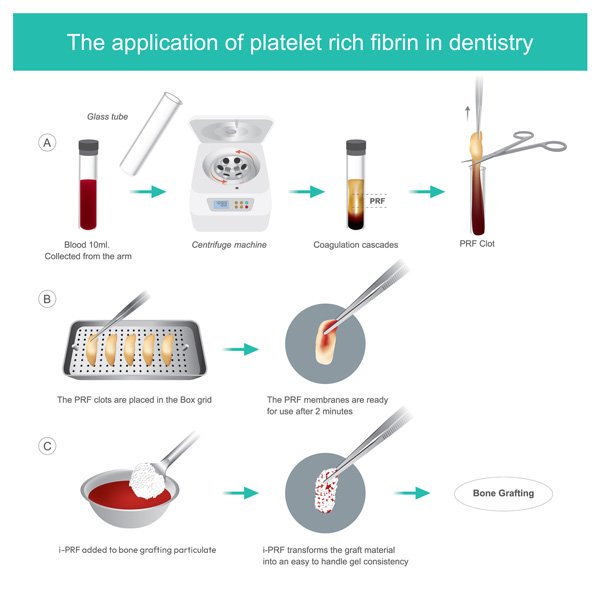
The socket is then prepared for regeneration using Platelet-Rich Fibrin (PRF) together with bone graft material.
PRF is created from a small sample of the patient's own blood. After centrifugation, we can isolate a fibrin matrix rich in platelets, leukocytes, and signaling molecules involved in normal wound healing.
The modern PRF concept was pioneered by Dr. Joseph Choukroun and has been extensively researched and developed by clinicians and scientists including Dr. Richard Miron.
When liquid PRF is combined with particulate bone graft, the fibrin begins binding the particles together. This creates a cohesive graft often called “sticky bone.”
We like this combination because the two materials have different jobs:
The bone graft provides structure and a scaffold.PRF provides an autologous fibrin matrix that supports the early healing environment.
Research supports alveolar ridge-preservation procedures for reducing the amount of bone loss that normally follows extraction, and PRF has demonstrated benefits for early soft-tissue healing and postoperative recovery.
5. Protecting the Graft with a PTFE Membrane
Once the graft is placed, it needs to remain protected and stable during early healing.
We use a dense PTFE membrane over the graft when indicated. The membrane creates a barrier between the regenerative space and the rapidly growing soft tissues above it.
This principle is known as guided bone regeneration.
Dense PTFE is particularly useful because it can protect a grafted extraction site while new tissue develops beneath it. Systematic reviews have demonstrated favorable ridge-preservation outcomes with dPTFE membranes.
6. Suturing and Stabilization
Finally, the area is carefully sutured.
The sutures help stabilize the soft tissue, membrane, PRF, and graft during the critical early stages of healing.
From beginning to end, each part of the procedure has a purpose:
Preserve the bone.Remove unhealthy tissue.Reduce microbial burden.Provide a regenerative scaffold.Protect it while the body heals.
Biology First
This approach is consistent with many of the principles being advanced in modern biologic oral surgery through the work of Choukroun, Miron, Curatola, Nischwitz, Judson Wall, and SDS/Swiss Dental Solutions.
The materials themselves are only part of the equation. Predictable regeneration still depends upon careful diagnosis, surgical technique, blood supply, graft stability, protection of the surgical site, and the patient's own healing capacity.
Our goal is to combine these established surgical principles with regenerative technologies in a way that respects the biology of the tissues.
When a tooth must be removed, how the site is prepared to heal afterward matters.
Research & Further Reading
- Avila-Ortiz G, Chambrone L, Vignoletti F. Effect of alveolar ridge preservation interventions following tooth extraction: a systematic review and meta-analysis. Journal of Clinical Periodontology. 2019;46(Suppl 21):195-223.
- Choukroun J, Ghanaati S. Reduction of relative centrifugation force within injectable platelet-rich fibrin concentrates: introduction of the low-speed centrifugation concept. European Journal of Trauma and Emergency Surgery. 2018;44:87-95.
- Miron RJ, Zucchelli G, Pikos MA, et al. Use of platelet-rich fibrin in regenerative dentistry: a systematic review. Clinical Oral Investigations. 2017;21:1913-1927.
- Al-Maawi S, Becker K, Schwarz F, Sader R, Ghanaati S. Efficacy of platelet-rich fibrin in promoting the healing of extraction sockets: a systematic review. International Journal of Implant Dentistry. 2021;7:117.
- Canullo L, Del Fabbro M, Khijmatgar S, et al. Dimensional and histomorphometric evaluation of biomaterials used for alveolar ridge preservation: a systematic review and network meta-analysis. Clinical Oral Investigations. 2022;26:141-158.
- Chatzopoulos GS, Koidou VP, Sonnenberger M, et al. Postextraction ridge preservation using dense PTFE membranes: a systematic review and meta-analysis. Journal of Prosthetic Dentistry. 2024;131:410-419.
- Sareen V, Santhi K, Saxena I, et al. Role of sticky bone in the management of alveolar bone defects: a systematic review. Cureus. 2024;16.
- Jauregui C, Chike G, Khoshneviszadeh S, et al. The use of ozone in oral health care: a narrative review of current evidence and clinical applications. Frontiers in Oral Health. 2026.